Can Stem Cell Therapy Cure Diabetes? What the Science Says
For ages, diabetes has been treated as a lifelong condition where the patient had to manage it rather than get cured. However, the area of regenerative medicine is changing that story. Stemming cell therapy is the major technique of this revolution – a method that dares to bring back the natural insulin production and possibly give a functional cure for diabetes.
But how far are we from that dream becoming real? So let’s get into discussion how the science sees stem cell therapy for diabetes, its success rates, costs, and challenges.
Grasping the Root Issue
To tell if stem cells could be a solution for diabetes, a review of the consequences is a must.
- In type 1 diabetes (T1D), the beta cells in the pancreas (the cells that make insulin) are destroyed by an aberrant immune reaction. This results in an interruption of the entire cycle of insulin production.
- Type 2 diabetes (T2D) is different, as it is marked by the slow decline in insulin sensitivity in the body and the eventual inability of the pancreas to produce sufficient insulin for the body’s requirement, which is a distinct case.
The end result in both scenarios is a relentless battle against high blood sugar and the necessity for constant care. Traditional methods of treatment—insulin shots, pills, and diet/exercise modifications—are all about alleviating the symptoms. No one is capable of taking the place of the beta cells that have died or been damaged.
Stem cell therapy is thus at the forefront with its and a regenerative approach that aims at reviving the body’s natural ability to produce insulin.
How Stem Cell Therapy Works for Diabetes
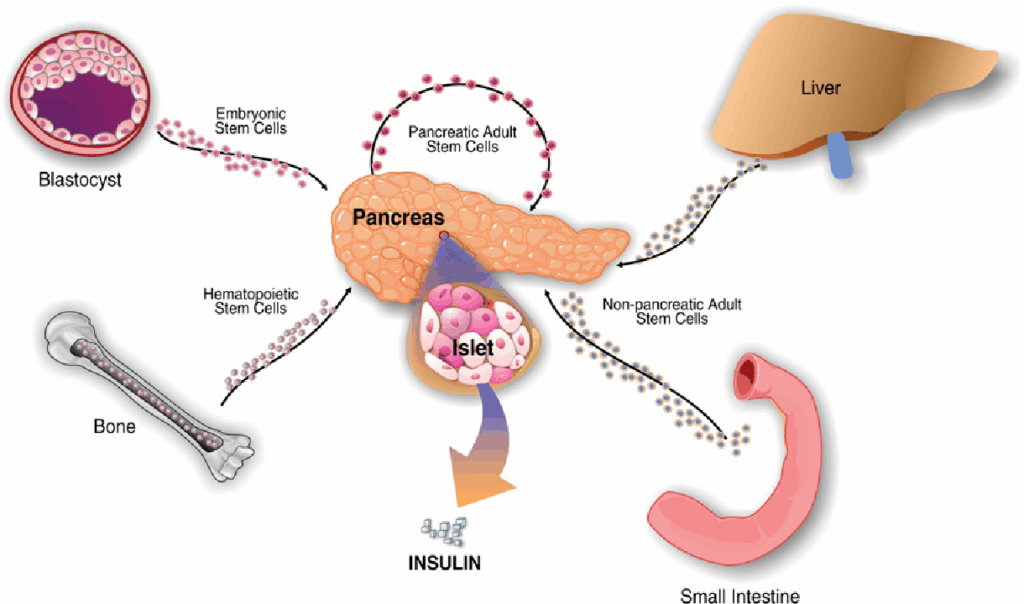
Stem cells are astonishing since one of their abilities is to differentiate into diverse specialized cells, beta cells of pancreas included. Different kinds of stem cells have been utilized in research and consist of:
- Embryonic Stem Cells (ESCs).
- Induced pluripotent stem cells (iPSCs) – essentially scientists have taken regular adult cells and “rewound” them to act like stem cells again.
- Mesenchymal stem cells (MSCs) – these cells are harvested from various tissues like bone marrow, fat tissue, or even from umbilical cords.
Anyhow, the researchers didn’t just take the cells and throw away them. They actually tinkered with them—engineered them, really—to turn into islet-like cells (think: tiny insulin factories). Then, they implanted those into the patient’s liver or pancreas, hoping that’d jumpstart insulin production. Sort of like installing a mini backup generator in a house where the power keeps going out. No magic wands, just some serious science hustle.
In addition to that, the recent technological advancements have opened a new direction of research wherein encapsulation of transplanted cells in protective barriers to prevent the immune system’s attack, which is a common problem in type 1 diabetes, is being considered.
Stem Cell Therapy for Type 1 Diabetes: Success Rate and Research
The development of stem cell therapy for type 1 diabetes is quite positive.
In Brazil, a randomized controlled trial consisting of 21 adults with type 1 diabetes was conducted and stem cell transplantation was used as a method to reprogram the immune system. According to the results, over 80% of study participants were not taking insulin at all for a period of at least two years and one of the subjects was off insulin for more than eight years. (Source: Stem Cell Research & Therapy Journal, 2024 — stemcellres.biomedcentral.com)
The VX-880 trial conducted by Vertex Pharmaceuticals was an important event in the area of drug development. The previous research had focused on the transplantation of human islet cells, derived from stem cells, into patients with the most difficult case of type 1 diabetes. The results were fantastic as a few patients in the trial gained a chance to significantly cut down or sto p completely their insulin injections. (Source: Diabetes.org Press Release, 2025)
Although the mentioned trials are very positive for the future of stem cell therapy, experts caution that we are still in the testing stages. There are still questions regarding the immune safety and long-term durability of transplants.
Nevertheless, the continuous success of stem cell therapy for diabetic patients, evidenced by the range of partial to full insulin independence, has been a significant factor in demonstrating that regenerative treatment is not merely a theoretical hope.
Stem Cell Therapy for Type 2 Diabetes: Where Does It Stand?
The case with type 2 diabetes is not only about the death of cells but also the body’s refusal to accept insulin. In this scenario, the use of stem cell therapy is directed at both the repair of pancreatic cells and the regulation of insulin sensitivity.
So far, there has been some evidence from clinical studies as well as a few observational studies that show blood glucose control may be improved, HbA1c levels may decrease, and a small proportion of the individuals in these studies could be insulin independent.
A meta-analysis published in 2021 in Frontiers in Endocrinology showed that patients receiving mesenchymal stem cell therapy had significantly improved glucose tolerance and pancreatic function than patients that were on standard care. (Source: Frontiers in Endocrinology, 2021)
It is worth noting that the likelihood of variability and success of stem cell therapy for type 2 diabetes is still quite low in comparison to type 1 diabetes.
A great part of this is due to insulin resistance—which is the most defining feature of type 2 diabetes—cholesterol of correction.
Though research is underway, using stem cells with anti-inflammatory and metabolic drugs may lead to better outcomes down the line.
What is the Cost of Stem Cell Therapy for Diabetes?
Although treatment is effective, stem cell therapy for diabetes is still not cheap. Due to most treatments being in the trial phase, prices differ according to place, type of treatment, and clinic reputation.
Here’s a usually followed pattern:
- India: ₹4–12 lakhs per session (for authorized clinical programs).
- Mexico / Thailand: From USD 8,000−8,000−15,000.
- United States / Europe: From USD 25,000−25,000−50,000. For some complex or multi-phase procedures, this can even increase to USD $100,000.
The FDA still has not classified these therapies among the standard treatments for diabetes, resulting in their low coverage by insurance. Moreover, patients are required to account for the costs of monitoring after the treatment and immunosuppressive therapy.
Can Diabetes Be Cured with Stem Cells?
Anyway, let’s be candid: Is there scientific evidence that stem cells can cure diabetes? To answer: Not yet, though we’re getting closer every day. Studies support the argument that stem cell therapy can make the patients less dependent on insulin or it can even completely eliminate the use of insulin in many cases, for example, in type 1 diabetes patients, especially. However, it might be a little too early to call it a full “cure” because most of the patients after three years still need insulin or medicine.
Experts refer to this as a “functional cure”—which stems cell therapy can almost rapidly glucose control and then quality of life is enhanced by such a large extent.
Still, no regulatory body (including FDA or EMA) has licensed a commercial stem cell cure for diabetes, however, the clinical trials which are at the later stages are moving fast.
Challenges and Safety Concerns
Even though the potential is great, there are still issues to contend with:
- Immune rejection: The immune system may destroy transplanted cells because they recognize them as foreign.
- Tumor development: Tumors may develop from undifferentiated cells because they are prone to atypical growth.
- Limited lifespan: The extent to which the transplanted cells can survive in the body for years is yet to be determined.
- Unregulated clinics: Certain clinics in various parts of the world claim to have “miracle cures” but do not have any scientific evidence to support their claims.
Therefore, it is the responsibility of the patients to guarantee that every stem cell treatment they choose is conducted under a monitored, moral clinical trial that has confirmed its safety through published data.
The Road Ahead
The growth of stem cell science has been at its peak for the last “ever so fast” researchers are already investigating.
- Immune-attack-resistant stem cells are being explored.
- No-more-immunosuppressants techniques that encapsulate the transplanted cells are also being researched.
- Individualized iPSC therapies are being developed too, where the stem cells would be derived from the patient’s own body thereby and rejection would be avoided.
If the long-term safety and efficacy are proven in the ongoing Phase 2 and Phase 3 clinical trials, stem cell therapy could be a widely used treatment over the next ten years.
Stem cell treatment has changed the perspective on diabetes control from a lifetime reliance to a possible regeneration. In the situation of type 1 diabetes, clinical trials indicate a lot of patients have become independent of insulin, on the other side of the story, type 2 diabetes has shown slow but steady results in getting better.
Nevertheless, it is still a hope therapy rather than a worldwide cure until long-term safety and affordability are established. Nature may not have vanquished diabetes yet — but through the rapid influx of stem cell research worldwide, that future no longer seems to be a distant dream.
FAQs on Stem Cell Therapy for Diabetes
What is stem cell therapy for diabetes?
Stem cell therapy for diabetes involves using stem cells to repair or replace damaged insulin-producing beta cells in the pancreas. The goal is to restore the body’s natural ability to control blood sugar levels.
Can stem cell therapy cure diabetes permanently?
While research shows promising results, stem cell therapy is not yet considered a permanent cure. It can improve insulin production and reduce dependence on insulin injections, but long-term studies are still ongoing.
How does stem cell therapy work in diabetes treatment?
Stem cells can differentiate into insulin-producing pancreatic cells. When injected into the patient, these new cells can help regulate glucose levels, reduce inflammation, and enhance tissue repair in the pancreas.
Is stem cell therapy safe for diabetic patients?
Yes, when performed by certified medical professionals using approved protocols. Since most therapies use the patient’s own cells, the risk of rejection or severe side effects is minimal. However, safety depends on the clinic and quality standards followed.
What results can patients expect after stem cell therapy?
Many patients report better blood sugar control, lower insulin requirements, and improved energy levels. However, the degree of improvement varies depending on the type of diabetes, age, and overall health.
Is stem cell therapy available in India for diabetes?
Yes, several research-based and clinical centers in India offer stem cell-based diabetes treatment under approved guidelines. Patients should always verify the clinic’s certification and ongoing research affiliations before proceeding.